Autoapp: what the launcher remembers
The engineer forgets everything between turns. The launcher does not: it writes down what the engineer did, at the moment it happened and with the identity it had then, so that a restart resumes where the person left off and a later step can learn from what went wrong. The design is in design.md; what is kept out of this record is in security.md.
This page covers what is written down, what is served back to the engineer from it, how a resolved case becomes a provisional lesson, and how a case is replayed so that the person confirming a lesson has evidence to confirm on. The model is called by the engineer's own turn, by the distiller, and by a replay or an evaluation a person starts; nothing else calls one.
Where
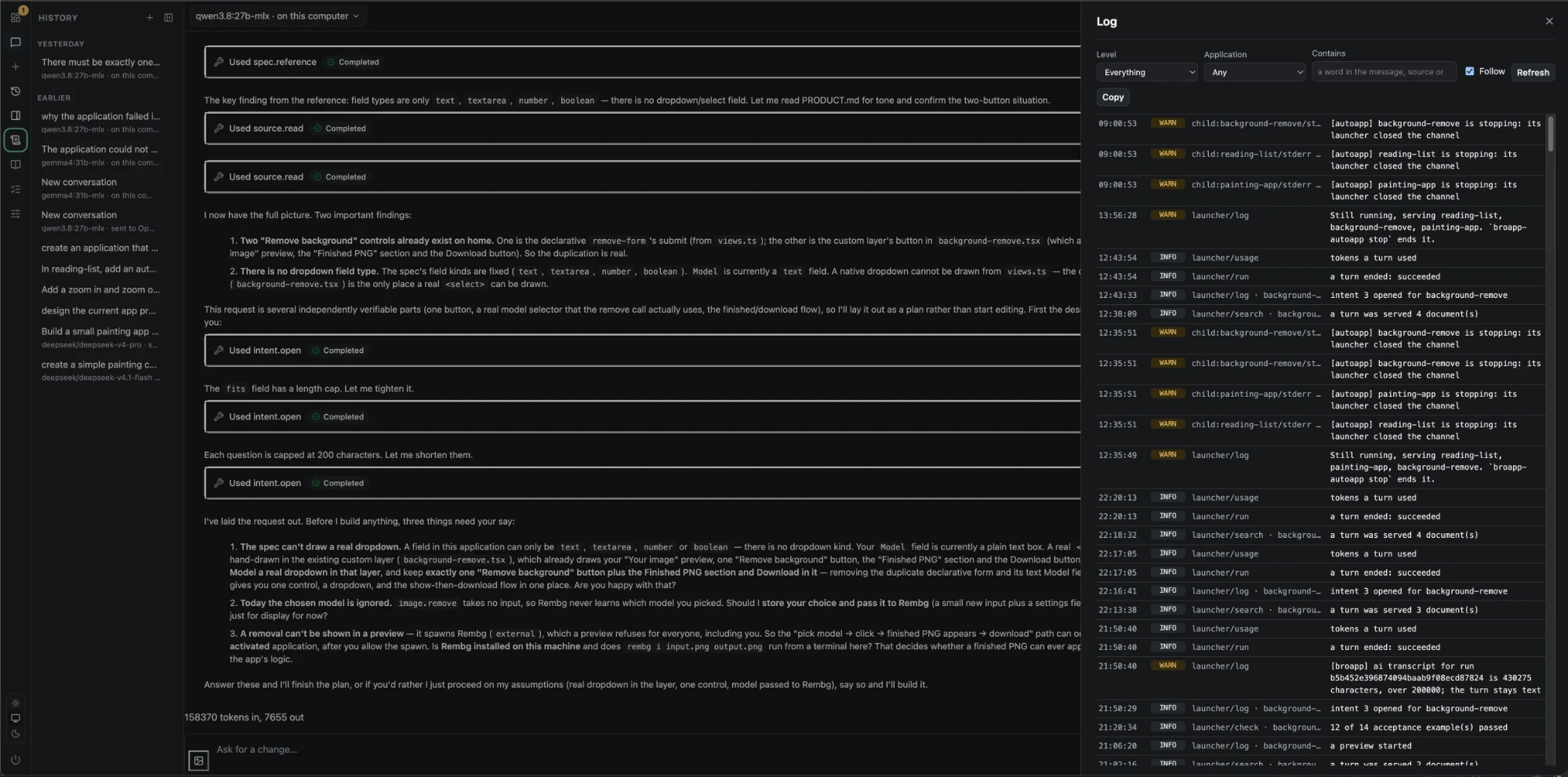
One SQLite file, <root>/launcher/knowledge.sqlite, beside the launcher's own runs.sqlite. It is opened by the launcher's long-running commands (serve, open, and the bare command) before anything else starts, so the first line a child prints is recorded. One-shot commands such as build and activate print to the terminal and write nothing here. The launcher's tab shows the events table as a log: the scroll icon on the rail opens it, newest first, filtered by level and application, refreshed every five seconds while it follows, with a copy of the shown lines for a bug report. The route behind it is launcher.eventsList, a read; a launcher started without the store answers that it keeps no log.
| Table | What it holds |
|---|---|
events | One row per build, check, edit, activation, turn, token count, child stderr line, and launcher warning. |
blobs | Text stored by the sha256 of its bytes: requests, instructions, system prompts, documents, acceptance examples. |
contexts | What each turn was given: the instructions, the system prompt as sent, and each delivered document. |
episodes | Cases. A failure, the edits after it, and the build or check that repaired it. |
lessons, lessons_fts, corpus_versions | Facts served to the engineer. Seven curated seeds, each written once when the table does not hold it, one corpus version each; and lessons distilled from cases. |
servings | One row per lesson a turn or a build failure was given, whether it reached the model, and what the next build or check found. |
replays | One row per replayed run: the case, the lesson under test, the arm, the outcome, the calls, time and tokens, and the manifest it ran from. |
The application the person last selected, by a row click or through any tool that names an application, is kept in <root>/launcher/session.json.
A window on it
The book icon on the launcher tab's rail opens the Knowledge panel, over the page like the log, with three views. It reads when it opens and when Refresh is pressed, never on a timer, and every read writes nothing.
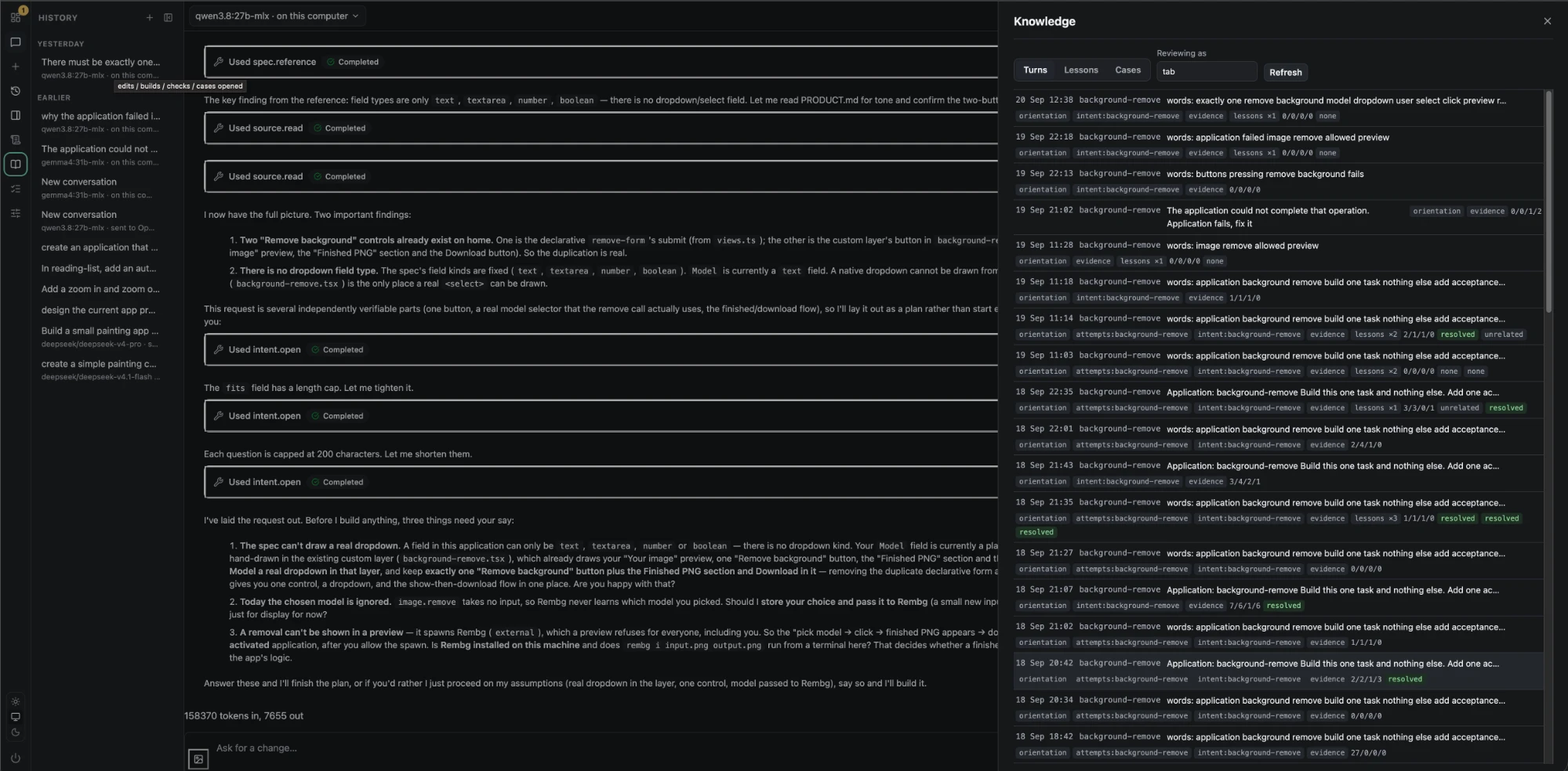
- Turns, newest first. One row per
contextsrow: when, the application,
the request (from the case the turn opened, when it opened one; otherwise the words its documents were searched by, because the request itself is kept only with a case), a chip for each document delivered — orientation, evidence, lessons ×n, struck through when the budget cut it — the turn's edits, builds, checks and cases opened, and one chip per serving with what came of it: resolved, recurred, blocked, inconclusive, unrelated, none, open, or not included. Opening a row shows each document's text as it was delivered, its byte count, the instructions' hash, and links to the lessons served. Read down the column of chips to see, turn by turn, what the loop delivered and what came of it.
- Lessons, filtered by status (provisional and confirmed by default) and
by needs review. Opening one shows its detail, trigger and applies, the case it came from with the distiller's diagnosis and reasoning, every serving, and the replay table knowledge show prints.
- Cases, newest first: stage, signature, open or resolved, the diagnosis,
the distil state and the lesson that came of it. Opening one shows the problem in full, the request, the edits appended while it was open, and the revisions and releases either side.
What a person may change from it is exactly what the command line can, and one thing more: Confirm a provisional lesson (or a confirmed one carrying a review flag, which clears the flag), Retire a provisional or confirmed lesson, Write a lesson by hand, and Replace a lesson with a corrected one. A written lesson is curated and confirmed, and its writer is its reviewer. A replacement is a new lesson with supersedes set; the old one becomes superseded and leaves the index in the same transaction, as the distiller's own supersession does. A lesson's text is never edited in place, so its servings and its case keep pointing at what was actually served. Retire and Replace ask inline first. A method_unclear lesson is shown and can be retired, and is still never served.
The writes are launcher.lessonReview and launcher.lessonWrite, routes on channel user with effect write; no engineer tool reaches them. They call the same functions in knowledge/review.ts that knowledge confirm and knowledge retire call, so the tab and the command line write the same rows — the lesson, its index row, one corpus version — with the name the person gave (Reviewing as, remembered in the browser, tab by default) and one log event saying who did it. The serve layer reads lessons from the database at every turn, so a change is served on the very next one. The command line still refuses to change anything while a launcher serves from its root; the tab is that launcher, so there is nothing to refuse. A launcher started without the store answers every knowledge route with unavailable.
Identity
Every row carries the run id, the call id, the application, the release and the source revision it had when it was written. The run and call come from the envelope the run loop gave the tool, never from anything the model said. A chat turn's request id is <runId>:<callId>; a person's click is a single-step run whose request id is both. The source revision is git rev-parse HEAD of the application's own workspace, or no-git when the workspace is not a repository of its own.
A row with no origin, such as a child's stderr line, stores NULL in those columns and keeps NULL. Nothing attributes a row to whichever run ended next.
Cases
A failed candidate.build opens one case per distinct failure. Two failures are the same when they differ only in a path, a line number, a quoted name, a hash or a number: the store normalises the message and hashes it with the stage, and that hash is the case's signature. A failed acceptance example opens a check case. A check case is identified by the example's content hash as well, so an example whose expect was edited is a different case.
A case records the person's request, the context row of the turn, the source revision and the running release before the repair, the model, and the launcher's version. Edits are appended while it is open, up to , characters.
A case is resolved once:
- A build case is resolved by the first build that ran its stage and
found nothing there. A build that stopped earlier says nothing about later stages, so their cases stay open. That is why a build result carries stagesRun: "the error is gone" and "the stage never ran" both look like an absent problem. A failing build still resolves the cases of stages that ran clean.
- A check case is resolved only by a pass of the same example content.
Evidence is immutable. Triggers in the database refuse any change to a case's opening columns, any change to its edits except an append while it is open, and any change to its resolution after the resolution is written. A diagnosis can be written once. The distillation bookkeeping (distill_state, distill_attempts) belongs to a later step and stays writable.
What a restart restores
The candidate panel's state is written to <root>/apps/<appId>/candidate.json on every change: the release that was built, the source revision it was built from, the problems, the stages that ran, the last checks and the preview each check ran on, and whether a preview was running. The preview process itself does not survive a restart.
After a restart the panel shows the same candidate and says three things:
- "The preview stopped when the launcher restarted." Open preview becomes
Start preview, which calls launcher.previewStart and then opens the preview.
- "Passed n of m for an earlier preview; run the checks again." A check
result counts as verified only for the release it ran against, on the preview child it ran on. A child is identified by its release and its spawn time.
- "Edited since this build." The workspace's
HEADhas moved on from the
revision the build was made from. This is computed when the panel asks, at most once a second, and is never stored.
What a turn is told
Every turn of the launcher's engineer opens with documents it did not have to ask for. They arrive through the AI layer's context providers, under the Rules that say documents are data, and nowhere else. The engineer's instructions change by three sentences only: read the documents first, and treat a build's hints as facts from earlier work.
- Orientation (
digest:<appId>, at most ,digest:<appId>characters). Eight lines:
the application, the current release and its schema version, the candidate and the revision it was built from, the files edited since that build, the last build's result, which checks are verified for the running preview, the preview, and the next verification step. Nothing in it that the candidate state does not say.
- Task evidence (
evidence:<appId>, at most ,evidence:<appId>characters). The routes,
views, migrations, acceptance examples and source symbols the request's words match, each with a file:line, followed by the migration numbering and the fixed constraints. When nothing matches it says so and lists the workspace's main files with their sizes.
- Supporting evidence. A
lessonsdocument with up to three lessons that
share at least two words with the request, or that apply to a route the task evidence names; and, beside a failed build, up to three hints that share a word with its problems and whose stage is exactly the problem's stage. A lesson that names no stage is never a hint (c watched the stageless MCP seed be hinted for a contract failure through the word "effect", and be credited with its repair). One shared word is not enough for a turn: in b's rerun "list" served the migration seed to a request about tags. A provisional lesson is labelled (provisional), and one a person should look at again (needs review: <reason>).
Which application. A builder's turn in a backlog run: its task's, found by the turn's exact run id (below). Any other turn: the one the message declares on a first line Application: <appId>; else the one it names by its id or a word of its name; else the one last selected; else the only one there is; else none, and the engineer uses apps.list.
How an entry is known. declared comes from the release specification the build validated — the candidate's when one was built, else the current one. pattern comes from five regular expressions over src/ (export function, export const, app.operation('…'), id: '…' in views.ts) and the migration ids in autoapp.json; it is a pointer to read, not a claim. A route whose handler no pattern found says handler: unknown — use source.search. The index does not follow imports, aliases or computed names.
Servings. A lesson is recorded as served only after the AI layer reports what it delivered. included = 1 means its whole line reached the model; a lesson resolved and then cut by the budget is included = 0 and is never scored. A hint is in a tool result, so it is always delivered.
Outcomes. Each delivered serving is closed once, by the first build or check that could say something about it:
| Outcome | Meaning |
|---|---|
resolved | The build ran the serving's stage and the failure it was served for was gone; or the check's example passed; or, for a turn serving with no failure, the build passed after the turn edited a file the lesson names. |
recurred | The same failure, by signature, was still there. |
blocked | The build stopped before the serving's stage. Only an event; the serving stays open. |
inconclusive | The example failed some other way: the child died, a step timed out, or a different failure. |
unrelated | A turn serving whose lesson names no file the turn edited, or a build that failed. |
none | The turn ended with the serving still open. |
A build never closes a check serving. None of these promotes, retires or ranks anything. An outcome is a fact about one attempt.
In-turn guidance. Every source.edit and source.change result carries verification: the edits since the last build in this launcher process, the last build's result, and next: candidate.build. From the third unverified edit it adds a warning. It is advice; nothing is refused and nothing times out.
The change cycle. The instructions send every change through candidate.cycle, which applies the hunks, builds, and when the build passes starts the preview and runs the checks, asking the person before the patch, the build and the preview. What it returns is the next thing to do: each build problem with the file, line and lines around it that it points at; whether those are the problems the last build had (the change did not reach them); or which examples failed and why. Its build and preview are the existing tools under their own request ids (<callId>.build, <callId>.preview), so their events, cases and servings are written down exactly as before.
Where a cycle stopped. Every step of a cycle — patched, built, previewed, checked, a build or preview the person declined, a failing build — is written to candidate.json with the workspace revision, the release, the failures by signature and the next step. A turn that was interrupted, by a restart or by running out, is picked up by the next one: its orientation says "Last cycle: built … and not checked — it stopped there" and "Next: candidate.cycle with no hunks, to finish verifying the last change". A cycle with no hunks and no files verifies the workspace as it is.
When it goes round. A failure is the same failure when its signatures are, for a build problem or a failed example alike, and a cycle says so (sameAsLastBuild, sameAsLastCheck). Three cycles in one turn that end with the same failure are the limit: the third says to stop, tell the person what was tried and ask how to go on, and a fourth in the same turn is refused. The person's next message is a new turn and the count starts again. A read the turn has already made twice, with nothing changed since, says so the third time; nothing is refused for it.
What a task's turn is given
A backlog run builds each task in a turn of its own (see intents.md). The executor moves the task to in-progress with the turn's run id before the turn starts, and the backlog records that pair in task_runs. search looks the run id up there, by equality: a run id is never parsed. When it names a task, the turn is that task's, whatever its message says.
The documents, in order. digest:<appId>, attempts:<appId>, intent:<appId>, evidence:<appId>, then the lessons. The AI layer offers at most eight refs a turn and cuts from the end when the budget is short, so the attempts document sits second: for a retry it is worth most. Five documents and three lessons fit the eight.
Earlier attempts at <slug> (attempts:<appId>, at most attempts:<appId>, characters, cut at a line). Offered only when the task has at least one earlier run. Per earlier attempt, oldest first, the newest never cut:
- Changed: the distinct paths the run's
editevents name, at most eight,
then "and <k> more".
- Ended with: the reasons its move to
failedgave, sentence by sentence. - Still wrong at the end: the problems of the run's last build, and the
failed examples of its last check when that check came after the build.
Then, once, Came back: any build problem, by signature, in the last build of two or more attempts, with the attempts named, so a builder does not try the same repair again. Then, when the planning model diagnosed the task's last failure, How the planning model read it: the diagnosis only; its advice and its note are for the person. An attempt that was interrupted says "stopped before it finished" and lists only what it changed. A move marked not an attempt: (a turn the provider killed, one that could not start, one that ended before the model did anything) is left out entirely. Everything passes sanitise; no model prose but the diagnosis is shown.
A task's lessons. Three tiers, filled in order up to three, no lesson twice:
- Pinned — as for every turn.
- Related — at most two lessons distilled from a case whose window edited a
file this task edited in an earlier attempt or named in its locks, with the same scope, status and method_unclear rules as a match, confirmed first, then newest. File overlap is a signal, not proof: two changes to one file can be about different things.
- Words — full-text matches on the task's own title, summary and criteria,
never on the builder's message, whose fixed sentences are the same for every task. Among them, a lesson about a stage the task's labels point at (STAGES_FOR_LABEL) sorts first.
A turn with no task is served exactly as before. A replay or an evaluation can turn the second tier off (corpus.related: false) and the attempts document off (documents.attempts: false). Nothing here ranks by outcome.
Turning them off. What is known is little. a's one retry (report) and b's ten replays (report), on one local B model, show no run in which the attempts document or the related lessons helped a retry, and none in which they were shown to harm one; nothing was measured on any other model. So both stay on, and a person can turn either off without a rebuild: task-context.json in the launcher's data directory, { "attempts": false, "related": false }, read like intent-models.json for every turn, where a missing or unreadable file, or a field that is not false, means on. A value a replay or an evaluation sets in code wins over the file. There is no panel control.
Why each document was there. The search event carries why, one entry per delivered document and per lesson whose line reached the model, each with a reason from a closed list: application, backlog, attempts, pinned, related:<file>, words.
The relationship index.
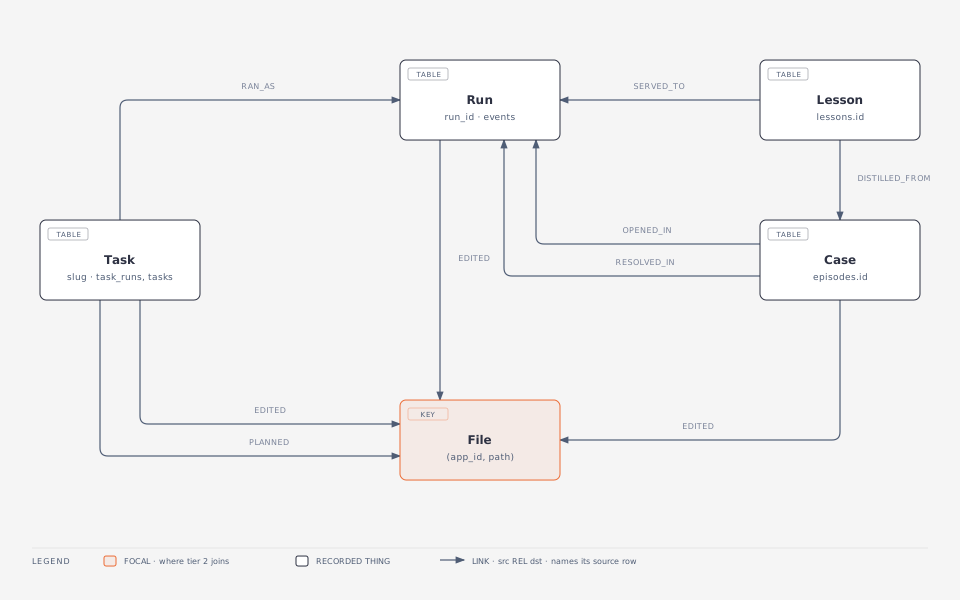
links in knowledge.sqlite records which recorded things touched which: a task ran as a run, a run and its task edited a file, a task planned a file, a case was opened and resolved in runs and edited files in its window, a lesson was distilled from a case and served to a run. A file is (app_id, path), the path relative to the workspace; two applications' files of the same name never join. Every row names the row it was read from (task_runs:<run_id>, events:<id>, episodes:<id>, lessons:<id>, servings:<id>, tasks:<id>) and carries no weight. It is derived: rebuildLinks rewrites it in one transaction when the launcher opens its stores and whenever a task's attempt ends, and dropping the table loses nothing. broapp-autoapp knowledge links [--app <id>] [--rebuild] prints the rows per relation and the locks entries that are not a file of the workspace; those are skipped, never guessed at.
Distillation
When a turn ends, every resolved case that has not been asked about is queued, and the engineer's own model is asked one structured question about each, one at a time, with a -second limit: what explains the failure, and could the engineer have known? The answer is one of six:
| Diagnosis | Meaning | What is written |
|---|---|---|
knowledge_missing | The fact it needed was nowhere in what it was given. | The diagnosis, and a provisional lesson. |
knowledge_not_retrieved | The fact existed as a lesson but was not delivered. | The diagnosis, and a search event with miss = 1 naming the lesson. |
method_unclear | The instructions covered it, unclearly. | The diagnosis, and a provisional lesson that is never served: it is the queue a person reads before changing instructions.ts. |
method_not_followed | The instructions were clear and not followed. | The diagnosis. |
tool_or_environment | A tool, the build or the machine failed. | The diagnosis. |
insufficient_evidence | The record cannot say. | The diagnosis. |
The diagnosis and the model's reasoning are always written to the case, once (episodes.diagnosis, as JSON). A case whose question fails stays pending and is asked again at the end of a later turn; after three attempts it is failed. A second question about the same case is a no-op.
What the distiller is shown. Blobs, never live files: the person's request; the instructions and every document exactly as delivered to the turn that met the failure, from its contexts row; the problem and its stage; the acceptance example for a check case; the edits, with how each hunk matched; both source revisions and releases; and the last events for the application while the case was open. When a lesson for the same failure already exists, it is shown too, with whether it existed at the turn's corpus version and whether it was among the delivered documents.
Why a lesson is provisional. A model's account of its own failure is a hypothesis. A provisional lesson is served, ranked below confirmed ones and labelled so; nothing in the launcher confirms, retires or promotes one. Every lesson records the case it came from, where it applies (stage, files, routes, and the failure's signature), the hash of the instructions it was written against and the launcher version that wrote it. A lesson whose text names a path on this machine, an address with a port, or anything shaped like a secret is dropped and the diagnosis kept.
Supersession. When the model says a new lesson has the same cause as an existing one, the new one records supersedes. An old provisional lesson becomes superseded and leaves the index. An old confirmed one keeps its status — a person confirmed it — and is flagged needs_review:superseded.
Review flags. On start, the launcher flags, and never changes the status of:
needs_review:recurring— served three times for a failure that came back,
and never once resolved, since it was last reviewed;
needs_review:instructions_changed— written for other instructions than the
running ones, and recurred twice since;
needs_review:autoapp_upgraded— distilled by a launcher of another minor
version, and never reviewed.
Reviewing. From the launcher binary, reading the database directly:
broapp-autoapp knowledge list [--provisional|--confirmed|--review|--method]
broapp-autoapp knowledge show <id>
broapp-autoapp knowledge confirm <id> [--by <name>]
broapp-autoapp knowledge retire <id>
broapp-autoapp knowledge export [--json]
list shows each lesson's servings as resolved/recurred/blocked/unrelated. show adds each outcome's count, and beside resolved how many of those were hints whose lesson named another stage, or none: "of which unrelated by stage". A repair resolves every hint served for its failure, the one that helped and the one that only shared a word, so that number is the noise in the count. confirm and retire record who and when, clear the flag and write a corpus version; retire takes the lesson out of the index. Both refuse while a launcher is serving from the same root, because it holds the database and serves lessons from memory. The engineer can read one lesson's detail with the knowledge.show tool (a read), which omits the reviewer's name and refuses a method_unclear lesson. The tool is for the id a hint names: a turn in the launcher was watched walking ids one after another, seven lessons in a row, because nothing said there was no list. Now the description and the instructions say so, a miss says so, and from the second lesson a turn reads in full the result says how many that makes.
Replay
A provisional lesson claims that knowing it would have avoided a failure. A replay tests the claim:
broapp-autoapp knowledge replay <caseId> [--with <lessonId>] [--runs n]It runs the engineer again on the case's original request, from the source revision the failure was met at, several times with the lesson and several times without it (three each by default, interleaved), and judges each run by what failed: a build case passes when the build runs the failing stage and no problem carries the case's signature; a check case passes when the acceptance example — the case's own, by its content hash, never the workspace's copy — passes on a preview of what the run left. Activation is never part of it. Without --with, the lesson distilled from the case is the one under test; with none, only the without arm runs.
What is held still. Everything is named in a manifest, written before anything runs and stored as a blob on every result row: the case, the two revisions and the release, the data snapshot for a check case, the hashes of package.json and the lockfile at that revision, the request, the instructions the replay runs with and the ones the case's turn was given, the example, the model, the launcher version, the lesson, the runs, the step cap () and the time a turn is given ( minutes; a run that runs out of time is judged by what it left). Each run is a fresh git clone of the workspace at that revision under <root>/replay/<caseId>/<arm>/<n>/, the workspace's own node_modules linked in, the release copied and made current, and for a check case a copy of the data. The corpus is frozen: the with arm is given the lesson under test on every turn and nothing else, the without arm no lesson at all, and curated facts reach neither. Orientation and task evidence stay on in both, because they are not what is being tested. The run answers the engineer's questions itself: yes to edits, builds and previews, no to activation and creation.
What a replay is not. It is the same machine, the same vendored dependencies and a copy of the data. It is not the same model sample and not the same conversation, and the instructions are this launcher's, which may have changed since the case. Cases do not record a data snapshot today, so a check case is replayed on a copy of the application's data taken the first time it is replayed; the manifest says from: live when that is so.
Where it writes. Each case's runs write to a store of their own, <root>/replay/<caseId>/knowledge.sqlite, logged with source replay, and nothing is distilled there. The launcher's own store gains the manifest blob and one replays row per run, and no serving, case or context: a replay can never be what a learning query learns from. Run directories are kept for a person to look at; the oldest beyond twenty per case are removed on the next replay.
The verdict. Printed beside the two arms, never applied:
| Word | Meaning |
|---|---|
supports | Passed only with the lesson. |
unrelated | Passed with it and without it. |
no effect | Failed both ways. |
against | Passed only without it — the case the other three leave out. |
inconclusive | An arm had no run that could be judged: every one failed on its provider, lost its preview child, or could not be prepared. |
After the arms, the regression set runs: every other resolved case of the application whose lesson is confirmed, replayed once with the new lesson and the confirmed corpus. A regression that fails is printed; it blocks nothing.
Confirmation stays a person's. knowledge confirm <id> prints the latest replay's table, its verdict and the regression results, and asks y/N; --yes skips the question. With no replay it says so — "no replay has been run; knowledge replay … first" — and confirms as before, because a person may have other evidence. No number here promotes anything.
Evaluation
broapp-autoapp knowledge evaluate [--runs n] [--out <path>] [--notes <dir>]The same harness, measuring the knowledge path itself: four tasks (the /c Notes request; "add a done filter to the items table" on the starter; "add tags to notes and a filter by tag" on Notes; and a priority with a filter by it on the starter), each under four conditions — baseline (no documents and no hints, the launcher before b), orientation (the digest alone), orientation+facts (b as shipped) and learned (that, plus every provisional and confirmed distilled lesson in the launcher's store) — n runs each on the configured model. Each task's acceptance example is added to the workspace before any run and judged from the evaluation's own copy, by hash. Each example says what must be there (with match, which ignores ids and timestamps a step cannot know) and what must not, so a route that returns nothing cannot pass; none can yet say that a change survives a restart or shows in the interface. The table gives two scores — working code (the evaluation built and previewed what the turn left, and the example passed) and workflow completed (the engineer itself checked the release it last built, with the example intact, and every example passed) — then calls to the first edit and to the first build, runs that reached a build, failed builds, model time and tool time apart, approvals, tokens, failure signatures that recurred from earlier runs, the files the turn's documents named that it then read or edited (and ignored), the files it read that nothing named, and the unrelated hint credit above. It installs nothing, so it is run from a checkout, where the workspaces resolve their dependencies from the repository.
The last two tasks are two turns. Turn one is the request, stopped the moment a call that edits has its result, as a person pressing stop would. Turn two says continue, with the request and turn one's words as history, under two history modes: text, where that is all it gets, and structured, where the assistant turn names turn one's run and the host gives the model that run's tool calls and results (see "What the host keeps per run" in the AI guide). Every condition runs both. The priority task is touch-file: between the turns the evaluation commits a comment line to src/shared/contract.ts, so turn two's source.read sees a revision turn one never saw. For orientation+facts a third cell runs turn two with the launcher restarted — a fresh harness over the same root and AI data directory — and the table marks it restart. Two-turn cells have their own table: working code and workflow completed as above, and for turn two the reads (source.read, source.list, source.search, spec.read, spec.reference) before its first edit, the repeated reads (a path, application or topic turn one had read), the repeated actions (a hunk whose find turn one applied, or a creation of something that existed), its tokens, turn one's calls, and for touch-file whether it read the changed file before editing it.
What notes-archived changed in the counting, and which published numbers it touches. An edit is now one that landed: a source.edit or source.change that succeeded, or a cycle whose patch applied (its build may still have failed). "Calls to the first edit" counts to that call, and a new "tried" column counts to the first attempt, refused or not, which is what the old column counted. Turn one of a two-turn task now stops at the first edit that landed; before, it stopped at the first attempt, so a refused edit could end it with nothing changed. Tokens are no longer zero for a turn that did not finish. The AI layer adds each step's usage as the step ends, a turn cut short by a limit, a stop or an error reports the steps that completed as partial, and the harness marks such a turn incomplete. "Mean tokens" is now the mean over runs whose every turn reported its total, printed with the count (85,024 (2/3), or — (0/3)). "Known tokens" is the mean of what every run is known to have used, a floor. The reports are history and are not edited, so read them this way. In notes-tagsd, both evaluation tables' "mean tokens" averaged a zero in for every timed-out run. A cell with timeouts understates its finished runs by that share, and a cell whose runs all timed out reads source.edit though they spent tokens: in the single run, baseline notes-archive and notes-tags, orientation notes-tags, and orientation+facts notes-archive and notes-tags; in the three runs, orientation and orientation+facts notes-archive and learned notes-tags. The summary's "on notes-archive from a million to eighty thousand" compares a baseline with one timeout against a learned cell with two, so it cannot be read as written. notes-tagsd's "calls to first edit" counted the first attempt, refused or not. In notes-tagsj, every two-turn row's turn one stopped at its first attempted edit, which may have been refused, so "turn-one calls" and every turn-two column measure a second turn after a first that may have changed nothing. Its token figures have the same zero for timeouts. orientation+factsb's "unknown" tokens are right, and the code now agrees with them.
Retention
When the store opens, events older than days are deleted, and then the oldest events beyond ,. Blobs older than days that no case or context refers to are deleted. Cases and contexts are never deleted.