Autoapp: the backlog
A request that is really five changes becomes one long turn, and the measurements in reports c, b and j say long turns are where a local model stalls. The backlog records what was asked, how it was split, and how far each part got. The launcher's rail calls it Backlog; the code calls it intent, because backlog.md already uses the word for deferred framework work.
This page describes what exists after prompt c: the store, the plan format, the tier rule, the routes, the panel, the engineer's tools that fill the backlog, and the executor that runs it.
Words
- An intent is one request from a person, analysed: the request as typed,
what it was understood to be, what it builds on, what conflicts with it, what is out of reach, what was assumed and what is still open.
- A task is one independently verifiable change inside an intent,
written as a plan.
Where it is kept
<root>/launcher/intents.sqlite, beside knowledge.sqlite. It has its own migrations under user_version, and uses the same pragmas as the knowledge store (WAL, foreign_keys, a five-second busy timeout). synchronous stays at WAL's NORMAL for the reason given in src/knowledge/store.ts: recovery reads nothing in this file. task_events is append-only, and triggers refuse any update or delete. The launcher opens the store for open and serve and closes it on shutdown. <root>/launcher/intent-models.json holds the model for each tier.
Statuses
An intent is draft, running, stopped, done or withdrawn. A person can withdraw a draft or a stopped intent. Every task it has not completed is then removed.
A task stores one of eight statuses. A ninth, blocked, is derived when the task is read and is never stored: it is an in-queue task with a blocker that is not completed.
Every change of status goes through moveTask. It refuses a move that is not in the table below, and it appends a task_events row in the same transaction.
| From | To |
|---|---|
proposed | in-queue, removed |
in-queue | in-progress, failed, removed |
in-progress | completed, failed, interrupted, needs-answer |
needs-answer | in-queue, removed |
failed | in-queue, proposed, removed |
interrupted | in-queue, removed |
completed, removed | nothing |
moveTask also stamps what a move means, in the same transaction, and nothing else writes these columns: in-progress sets started_at, clears ended_at, adds one to attempts and appends the run id to run_ids; completed and failed set ended_at; interrupted and needs-answer set ended_at and take the attempt back, because neither was the builder's failure. in-queue → failed is a task whose model is no longer offered, which fails without a turn; failed → proposed is a failed task the engineer revised after a run stopped.
needs-answer is a task whose builder asked the person a question. The question is in question, and every { question, answer, at } so far is in answers. When an intent is withdrawn, a failed or interrupted task goes straight to removed, with one event. It never waited in the queue, so its history does not say it did.
Tiers
The host computes a task's tier. A model never supplies it. The model gives reasoning (low, medium or high), and that is one input to the rule.
| Tier | When | Reason given |
|---|---|---|
deep | risk is high | It is marked high risk. |
deep | labels include migration | It changes a migration. |
deep | reasoning is high | It needs deep reasoning. |
deep | estimated_lines over | It is estimated at more than lines. |
deep | two or more blocked_by | It waits on two or more other tasks. |
light | no deep rule applies, lines or fewer, reasoning is low, and every label is views, theme or copy | It is lines or fewer, needs little reasoning, and touches only views, theme or copy. |
standard | anything else | It is neither small enough to be light nor risky enough to be deep. |
A task runs on its own model when a person chose one. If not, it runs on its tier's model from intent-models.json. If that is null, it runs on the model chosen in Settings. A model is a reference: a bare id is a model of the provider in use, and <provider>:<model> (ollama:qwen3:27b) is a model of that provider, run with its own key and address. A provider that is not turned on in Settings is sent nothing: the task fails with "<provider> is not turned on in Settings." before its turn starts. A provider that fails fails the task; nothing falls back to another provider.
The plan format
The rows are the source of truth. The markdown is a view of them: the host renders it, and nothing parses it back.
---
title: <imperative summary of the one change>
priority: high
labels: [views]
blocked_by: []
estimated_lines: 120
locks: []
risk: normal
stub: false
---

One or two sentences: what this is and why it exists.

## Acceptance criteria
- [ ] <observable, testable outcome>
- [ ] (when it goes wrong) <the route that refuses, and what the person is told>
- [ ] Every criterion above has exactly one test named after it

## Non-functional
- ...

## Test notes
- ...

## Human runbook
- ...
repaid_by: <slug>followsstub:only on a stub.- A criterion with
failure: truerenders with(when it goes wrong)before
its text. Its example is a route step with fails, which passes only when the route refuses (see the acceptance topic); the builder's message says so, so a builder does not read it as contradicting the other criteria.
- A task with a
no_failure_pathreason renders `- [ ] No failure path:
<reason>` in place of a failure criterion.
- The host writes the last criterion. Criterion
c2of task0007-add-tags
is tested by the acceptance example 0007-add-tags-c2.
- A slug is
NNNN-words. The number is the next free one for the
application, across all of its intents. The words are at most six, lowercase.
- Labels come from a fixed list:
contract,host,migration,views,
theme, acceptance, copy. A task has one to four.
- Priority is
high,mediumorlow. Risk ishighornormal.
validateTask names the field of each problem. validateGraph refuses a cycle in blocked_by, and names every slug in the cycle. It also refuses more than twelve live tasks in one intent.
Run order
runOrder sorts blockers first, then priority (high first), then slug. The panel and the executor use the same function.
How a request becomes a backlog
A request with more than one change that can be checked on its own, or one the engineer estimates at over changed lines, is planned rather than started. A single small change is still made directly. The engineer's instructions say so, and the intents topic of spec.reference has the details.
- The engineer reads the application with
spec.read. intent.openwrites the analysis: the request restated, what it builds on
(fits), conflicts, what is out of reach, assumptions and questions. The request itself is the message the person typed, taken from the turn the tab recorded. An application has at most one draft: a second intent.open replaces the analysis of that draft and keeps its tasks and its request.
- With questions, the engineer asks them in the chat and stops. The panel shows
them first, under The engineer needs answers. The answer starts a new turn, and the engineer calls intent.open again with the answers folded in and no questions left. Until then intent.task and intent.submit refuse.
intent.taskadds one task at a time. A plan problem comes back as
ok: false with each field named, and nothing is stored, so the model repairs the plan as it repairs a failed build. replaces rewrites a task that is still proposed and keeps its slug. A runbook line that names an external route of the serving release and the word "preview" is one such problem: the gate refuses external in a preview for everyone, the person's own click included, so the line has to say "after activating". A route the task has yet to add is not known then, and a line that describes a button in words is not guessed at. A criterion is refused the same way, since each one becomes an acceptance example the preview has to pass: one that names an external route of the serving release, or says "after activat…", "not in a preview", "only after" or "in the activated" (case aside, whole words where the phrase has them). The news plan of -- wrote "checked after activation, not in a preview" as a criterion of a task scheduling a refresh, and its examples passed on the gate's refusal. What only the activated application can show goes in the runbook, as "after activating, …". A route the plan itself adds is caught by the words, or by the build, which refuses a step on it.
intent.submitchecks the whole plan and stampssubmitted_at. Until then
the panel shows the draft as Being written. The engineer tells the person, in a sentence or two, that the plan is in the Backlog panel, and stops.
A turn that called intent.open or intent.task cannot edit or build: source.edit, source.change, candidate.build and candidate.cycle answer "This turn planned a backlog. The person reviews it first." The next turn can.
Every later turn about an application with an intent in draft, running or stopped is given a document, intent:<appId>, "The backlog for <appId>", after the orientation: each live intent's status, its open questions, and one line per task with its slug, status, tier and title, and a failed task's reason. It is at most running, characters, and the turn's context row records it like any other document.
Each accepted call writes one log event: intent 4 opened for notes, task 0007-add-tags proposed (deep), intent 4 submitted with 5 tasks.
What the host checks and what the model decides
| The host checks or decides | The model decides |
|---|---|
| The request, from what the person typed | The restatement of it |
That fits names a route, page or component of the release that is serving, as a whole word (skipped for an application with no routes, such as the blank) | Which parts of the application the request builds on |
| One draft per application; no new analysis while an intent runs | Whether the request needs questions answered first |
| That nothing is split while questions are open | The questions |
| Every field of a task against the plan format | Titles, summaries, criteria, labels, estimates, priority, reasoning |
That no criterion and no runbook line needs a preview to do what it refuses: an external route, or the words that say "after activating" | What the preview can show, and what goes in the runbook |
| The slug's number, the criterion ids, the tier and the model | The slug's words |
That every blocked_by and repaid_by names a task, and that there is no cycle | How the work is split and what waits on what |
| That a turn which planned does not edit or build | When to plan and when to change directly |
That a draft leaves draft only by a person, or a tool that asks one | Nothing: the engineer cannot start a task |
| Whether a task is completed, from the verdict below | Nothing: its closing words are not evidence |
How a backlog runs
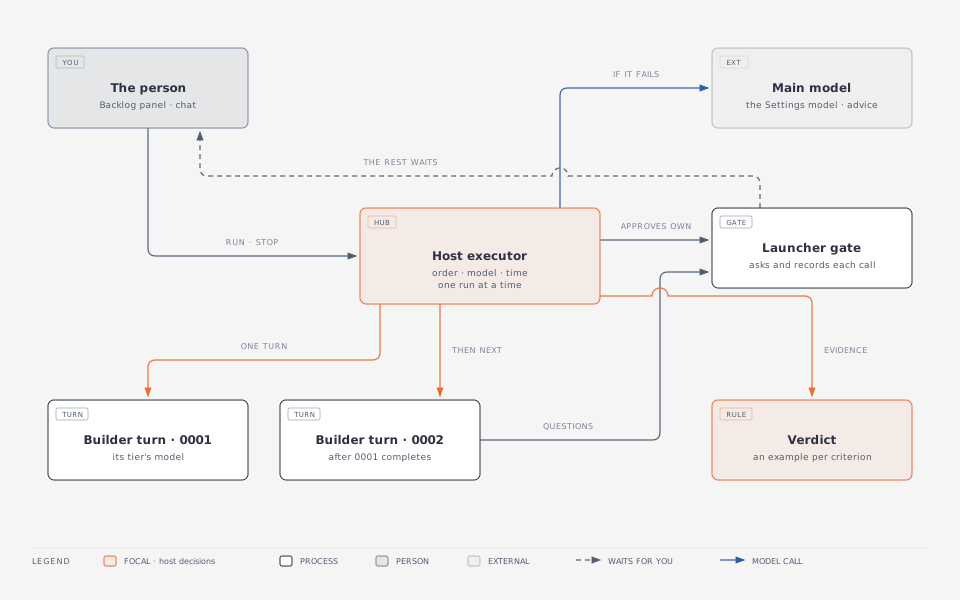
The hub is two things. The host executor (src/intent/executor.ts) is deterministic code: it decides the order, the model, the time allowed, whether a task is finished and when to stop. The main model, the one chosen in Settings, is asked where judgement is needed: once for advice when a task fails, and on the person's next chat turn, where the intent:<appId> document tells it what happened. No model supervises another; reports c and j measured what a local model does with one long open-ended turn.
- The person says to go ahead in the chat (
intent.start, which the gate asks
about) or presses Run in the panel (launcher.intentRun, behind an inline confirmation). Both say what is being agreed to, and both call executor.start.
- Start requires a submitted draft with no open questions, or a stopped
intent whose live tasks form a valid graph; no task waiting for an answer; something left to run; no other run in this launcher; and AI set up. It moves proposed, failed and interrupted tasks to in-queue, sets the intent running, and returns at once.
- One task at a time, in run order. Each is one engineer turn, run id
intent-<intentId>-<slug>-a<n>, with no history, on modelFor(task): its own model, its tier's, or the Settings model. A model the provider no longer offers fails the task without a turn.
- The builder's message starts
Application: <appId>(the turn's documents are
chosen from its run id, which the backlog records in task_runs; the line is for a reader), says to build this one task with one example per criterion under exactly the ids <slug>-c<n>, to use candidate.cycle until every check passes, not to remove, rename or change an example already there (and, if an older one fails, to cycle once more on a fresh preview before saying with intent.ask whether the change or the plan is wrong), and not to activate or plan. Then the plan, then any answers the person gave, then why the last attempt was not completed.
- During the turn the executor answers the gate for the person, as described
in security.md. A question it does not cover waits in the panel.
- When the turn ends, however it ended, the verdict decides. A turn that
makes no tool call for eight minutes is ended first (the clock holds while a tool runs and while a question waits for the person), and the verdict says so: "The turn made no tool call for minutes." The twenty-minute limit stays. A turn refused four times for the same reason (the same tool and the same kind of refusal, as the verdict groups them) with no edit landing in between is ended too, and says so: "The turn was refused times for the same reason: candidate.cycle: create: expected an array." Four is a choice, not a measurement. Such a turn costs an attempt, as an idle ending does. A turn that ended on its own — not aborted by either limit or a Stop, not a provider ending, not a question — with edits nothing built is built once by the host first: one candidate.cycle with no hunks and no files, through the same gate, under the turn's run id, answered by the run's standing answer. Its request id is <runId>:host-build, a log event says the host made it, and a task that completes on it says "completed after the host built what the turn left unbuilt". The builder's closing words are still not evidence; the build and the checks are.
- Completed: the next task. Not completed: another attempt with the reasons.
Two attempts that do not complete stop the run, but an attempt that passed more criteria than every earlier one of this run is not counted, and its history says "another attempt: it got further ( of )". Four turns a task is the ceiling, however much each improves.
- Every task completed: the intent is
done. Nothing is activated. The panel
says to open the preview, look, and activate from the Candidate panel, and lists every task's runbook lines under "For you to check by hand". A line naming an external route of the release its task completed at is marked "(after activating)", and a sentence above the list says why.
A task is completed only when all of these hold after its turn: the workspace revision moved since before the task's first turn (so an attempt that only builds what the last one edited counts); the last build has no problems; nothing was edited after it; its checks ran on the preview that is running now; every check passed, so no earlier task's example regressed; every example of the application's completed tasks is still among the checks ("The example rev_after-author-column-ccandidate.cycle, from a finished task, is gone."), so none was removed to make that true, and each still has the steps it had when its task completed ("The example rev_after-author-column-ccandidate.cycle, from a finished task, was changed."), so none was rewritten to make that true either; and for every criterion an example named <slug>-c<n> ran. An example with a step on an external route of the release its task completed at is not held: it passed on the preview's refusal, the build now refuses it, and a later task has to remove it before anything builds. That is decided where the required examples are gathered, in the executor, not in the verdict. Otherwise each condition that did not hold is a sentence ("No example named git diff --shortstat-add-tags-ccandidate.cycle was run.", "The turn ran out of time."). When nothing was built, the sentences after "Nothing was built." say what the tools refused, read from the gate's own record of the turn in the launcher's run store: one per refused group of candidate.cycle and candidate.build ("candidate.cycle was refused candidate.build times: create: expected an array."), at most three, then one for every refused edit (" edits were refused; most often: message: expected a string."). A completed verdict never mentions refusals, and a call the gate denied is not a refusal. A completed task records rev_after, release_id and actual_lines (from git diff --shortstat), and for each criterion the hash of its example's steps (not its title) in the specification the completing build was made from; a task completed before those hashes were kept is held by its examples' ids alone. Each criterion whose example passed is drawn [x] in its plan. A verdict is only as strong as the examples the builder wrote; the backlog's A verdict as strong as its examples row says what would strengthen it.
Failure policy: stop. After the second counted attempt, or the fourth turn, the task is failed with its reasons and run ids, the intent is stopped, and later tasks stay in-queue. The workspace is left as the attempt left it, so the person and the engineer can look; nothing is reset. The main model is then asked one structured question, { diagnosis, advice: retry | revise | split | ask, note }, and the answer is shown under the failure. The question is told what the tools refused in the last attempt and the one before, and that when a builder's calls were refused for their input the plan is not at fault and another model may be the answer. It stays there when the task is queued again and goes when the task completes or is revised. An answer that does not arrive or does not parse stores nothing and changes no status. From there the person runs again (failed and interrupted tasks are queued, and the run continues from the first unfinished task), or asks the engineer to revise the failed task with intent.task and replaces, which returns it to proposed.
What a retry is told, and where it is read from. An attempt after the first is told, in its message, "The last attempt ended with:" and the reasons. Inside one run those come from the verdict just taken; at the start of a run they come from the task's own history, the newest move from in-progress to failed or interrupted (attemptNotes), so a task resumed after a stop or a launcher restart is told the same. The message cannot be cut by the context budget. The turn is also given the attempts document (see learning.md): what each earlier attempt changed, how it ended, what was still wrong, what came back, and the planning model's diagnosis, read from the knowledge log's events for each run id in task_runs. An earlier attempt that edited nothing also says what it read (at most six paths, from the launcher's run store, which already records every source.read). The document says what happened and never what to do: b closed it with an instruction to start from an edit when the newest attempt changed nothing, both retries given it began by reading a file it named, and d took it out. Each earlier attempt also says what its tools refused (Refused:, the three largest groups), so a builder whose every cycle was refused for its input is not left to send the same call again.
A repeated refusal shows a valid input. Inside one turn, the second time a tool is refused for its input with the same error, the error goes back to the model with "A valid input looks like:" and one minimal example of that tool's input, held to the tool's own schema by a test. The second hunk that matches nothing in the same file adds "Read the file again before another hunk: what you remember of it is not what is on disk." A first refusal is unchanged, no tool accepts anything it refused before, and what a turn was refused is forgotten when the turn ends.
A turn the provider killed is not an attempt. When the AI provider fails during a builder's turn, the turn cannot start, or it ends failed before the model made a single tool call, no verdict is taken: the task moves to interrupted (the attempt is given back) with a note beginning not an attempt:, the intent stops with "The AI provider returned an error while building <slug>. Nothing was judged. The launcher's log has the detail." (or "…ended before the model did anything…"), no advice is asked, and the next task is not started, because it would meet the same provider. The note carries the AI layer's reduced sentence, never the provider's raw text. A turn the idle clock, the time limit or a Stop ended is judged as before.
A builder that is unsure asks. intent.ask records one question on the task, moves it to needs-answer, stops the intent with "<slug> needs an answer", and ends the turn without counting the attempt. The person answers in the panel (launcher.intentAnswer), which returns the task to the queue; they then press Run. At most two questions per task; a third is told to decide with what it has.
Stopping. launcher.intentStop aborts the turn: the task is interrupted, the intent stopped "by the person", and the preview is left as it is. While a run is going, other turns may read the application and talk to the engineer, but every tool that writes to that application, and launcher.activate, is refused until the run stops.
Stopping the launcher — Quit in the panel, broapp-autoapp stop, or Ctrl+C — stops a run the same way: the task in hand is interrupted with its attempt given back, and the intent stopped.
A restart interrupts and never resumes. When the launcher's tab opens the store (openIntents(…, { recover: true }); serve <appId> and the one-shot commands open it without, because a launcher beside them may be running), any in-progress task becomes interrupted (attempt given back) and any running intent becomes stopped, "The launcher stopped." An interrupted turn may have left half a change, and a person decides what happens to an outcome nobody saw.
What a run costs, and where it is
Every turn the launcher runs leaves one row in intents.sqlite's usage table when it ends: a chat turn, a planning turn, a builder's turn, the advice question about a failed task, and each distillation question. A builder's row carries its task, found by its run id in task_runs. A turn cut short writes what its completed steps used and is marked partial; a turn whose provider never reported anything writes zeros, also partial, because its cost is unknown rather than nothing. While a turn runs, what its completed steps have used so far is held in memory from the AI layer's onUsageSoFar hook, and the row replaces it when the turn ends.
Prices are the person's. prices.json in the launcher's data directory, beside intent-models.json, says what a model costs in US dollars per million tokens, and optionally a daily budget:
{ "z-ai/glm-5.3": { "input": 0.6, "output": 2.2 }, "budget": { "day": 10 } }Nothing ships with a price and nothing fetches one. A model the file does not name has no cost, only tokens; a missing or unreadable file prices nothing. Cost is worked out when read, so correcting a price corrects every earlier day too. A total that includes a partial row or a running turn is a floor (atLeast), a total that includes an unpriced model says how many tokens it left out (unpricedTokens), and a total in which nothing is priced has no cost (null), never 0. The budget is shown and never enforced.
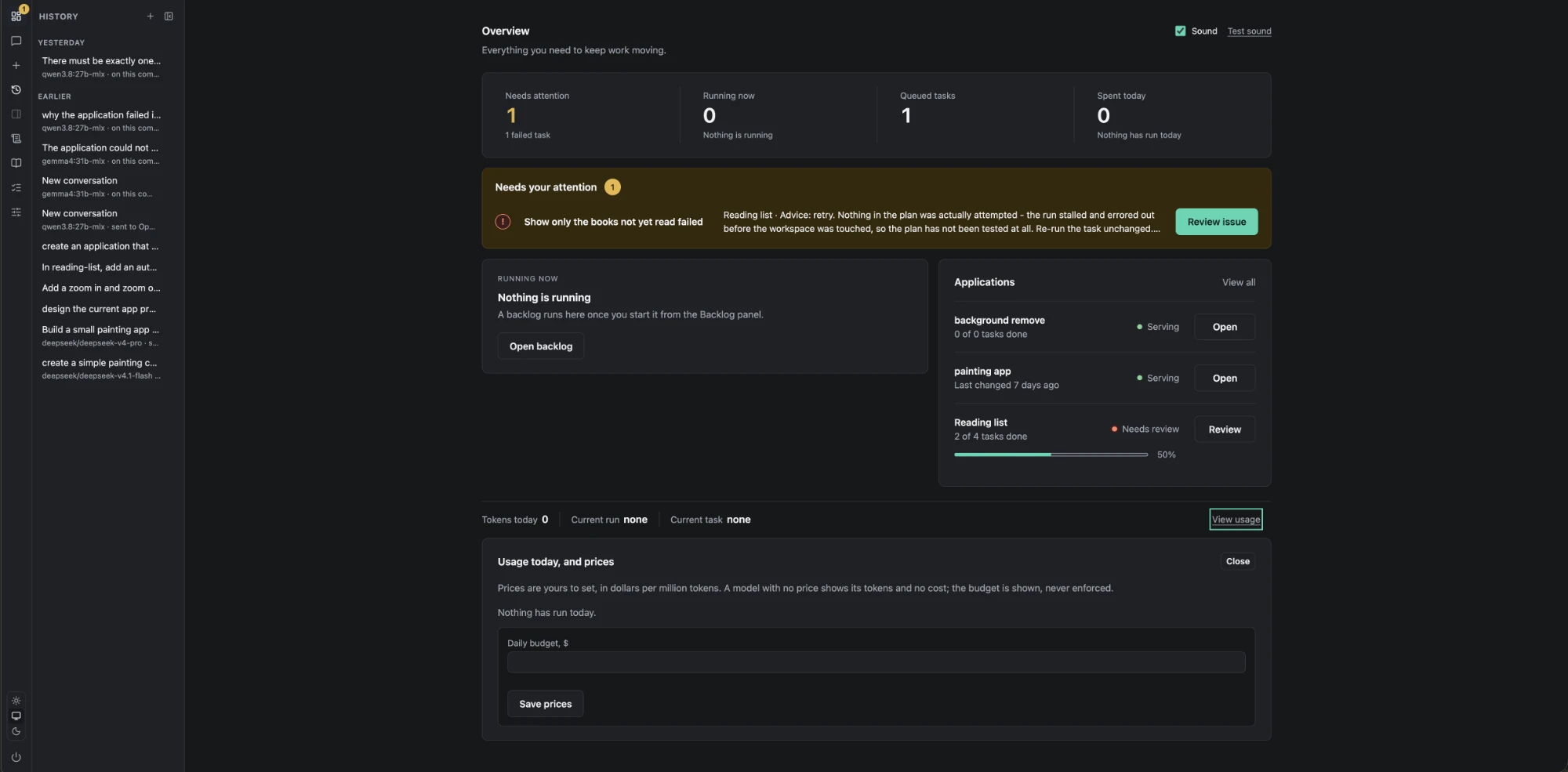
launcher.overview answers in one read what needs the person (a question a run is waiting on, a task that asked, a failed task whose advice is unanswered, a candidate whose own checks all passed and is not serving), the task in hand with its stage (reading, editing, building, checking), its limits, its criteria passing and its last refusal, spend for the task, the run and today, what is left per application with an estimate once two of its tasks have completed with whole rows, each application's state, and the run events a page raises alerts from. It starts nothing and writes nothing.
Routes and the panel
The reads are launcher.intentsList, intentGet, intentPlan and intentModelsGet. The writes are launcher.intentTaskModel, intentTaskRemove, intentWithdraw, intentModelsSet, and since launcher.intentGetc intentRun, intentStop and intentAnswer. Each write is a write that is accepted only on channel user. No engineer tool names any of them. launcher.intentGet carries the run's progress (run: the task in hand, its turn, when it started, its last tool, how many approvals, and a question waiting for the person), and launcher.intentRunning says whether any run is going and waiting. If a launcher has no store, every one of these routes answers unavailable.
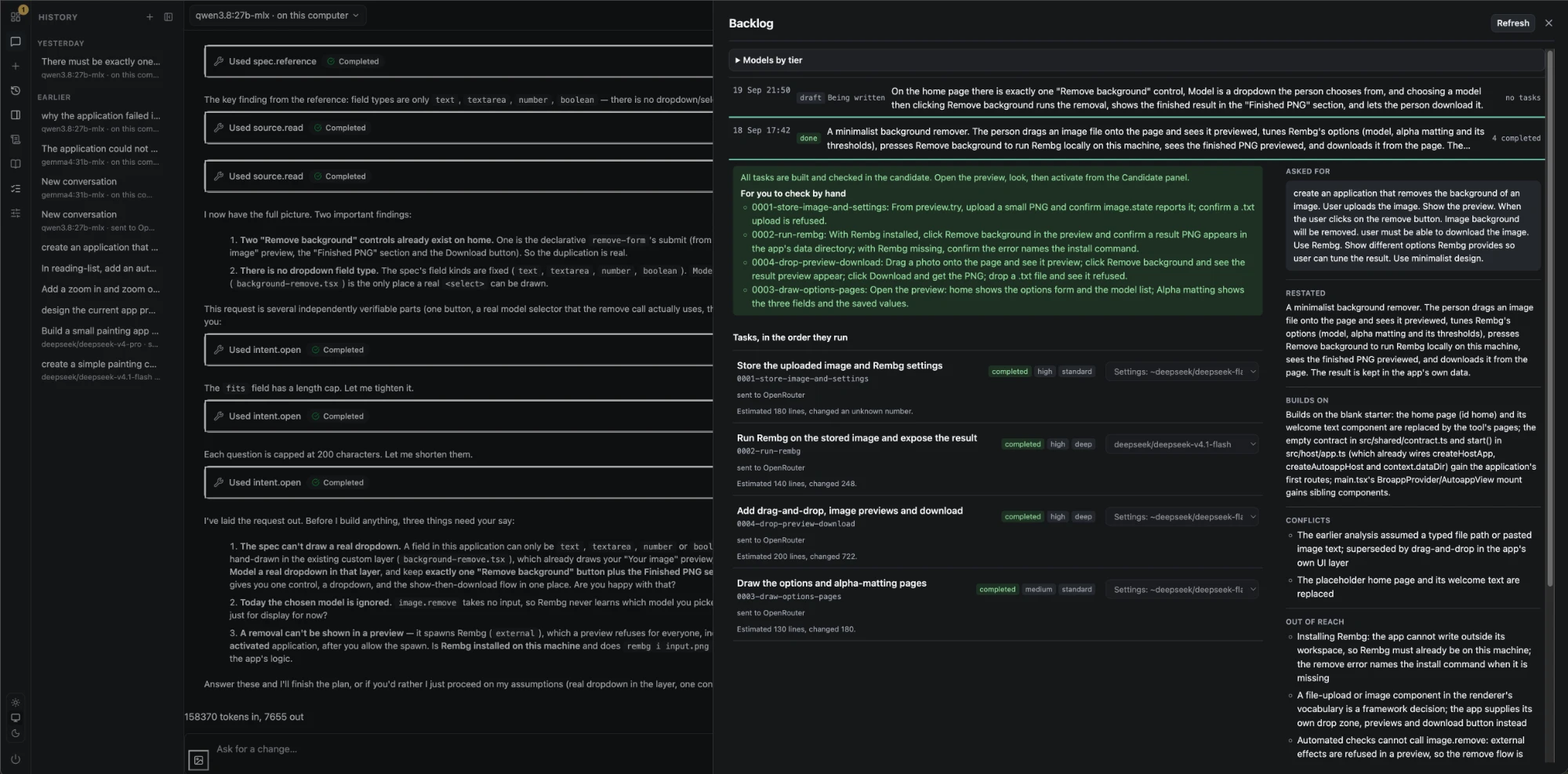
The Backlog panel shows the intents of the application selected in the launcher, newest first. Open an intent to see the request, the analysis and the tasks in run order. Each task shows its slug, title, priority, tier (the reasons are in the tooltip), model, status and the tasks it is blocked by. A person can change a task's model, open a task to read its plan and history, remove a task, withdraw the intent, and set the three tier models. Each of these is refused with a sentence when the rules above do not allow it. A draft the engineer has not submitted shows Being written beside its status, and a draft with open questions shows them first.
A submitted draft or a stopped intent has Run, and a running one Stop, each behind an inline confirmation. While a run goes, the task in hand shows its last tool; a failed task shows its reasons, the main model's advice and "Run again to retry, or ask the engineer to revise this task."; a task waiting for an answer shows the question and a box to answer it. A question the run brought to the person is shown at the top with Approve and Deny, answered through ai.chatConfirm, and the rail's Backlog button is marked while one waits. The panel reads again every two seconds while a chat turn runs, while the open draft is being written, or while a run goes, and never otherwise.