Architecture
The shape of the thing
A Broapp application is one operating-system process. It binds a loopback socket, serves one HTML document over it, and opens the user's browser at that document. The browser then talks back to the same process over a WebSocket on the same origin. When you compile it, the HTML document is inside the executable, and so is the JavaScript runtime.
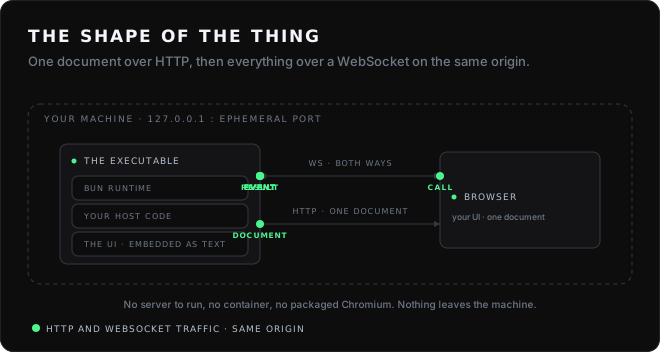
Nothing leaves the machine. There is no server to run, no container, no packaged Chromium.
Four layers, and who owns what
Brobridge owns the connection. The trust fence that checks Host and Origin, the one-time launch token, the HMAC-signed session cookie, the frame codec, stream multiplexing, credit-based flow control, and resume after a dropped socket are all in Brobridge and are used unchanged. Broapp does not patch, fork, or vendor any of it, and does not weaken a default to make development convenient.
Broapp owns the developer experience. The contract and its validation, the error boundary, the stream framing, the lifecycle, the build, the generator.
Your application owns the operations and the interface.
The AI layer, when an application turns it on, owns the fourth. It is optional, it is host-only, and it is provider-independent: settings and key storage, the context an application chooses to expose, tools derived from the contract, and the confirmation step before a tool changes anything. It runs in the host process because the browser cannot reach a provider — the page's content-security policy allows 'self' and loopback and nothing else — and because a key in a page is a key that has been published. An application that does not call createAi carries none of it.
Its browser half is a choice of two panels over the same routes: AiChat from broapp/ai/react, which adds no dependencies and renders text; and BroappChat from broapp-ai-elements, which puts the AI SDK's useChat and Vercel AI Elements over the same bridge for markdown, image attachments and tool cards. Neither reaches a provider — both speak ai.chat to the host. See the AI layer.
This split is why the interesting security properties are not Broapp's to get wrong. It is also why Broapp is small.
Autoapp builds a fifth thing on top of these four — an application its owner can reshape while using it — and it is where the execution gate every call now passes comes from; see the Autoapp design.
The constraint that decides the packaging
Brobridge's route table is exactly three entries: /, /ws, /rpc. There is no static file route — deliberately, so that nothing about the bridge ever touches the filesystem in response to a request.
That single fact settles how a Broapp UI is packaged: it must be one document, with its CSS and JavaScript inline, because <script src="/app.js"> would . broapp build therefore bundles the browser entry point, inlines the result, and refuses to emit a page that loads anything from off-origin.
It suits a single-file executable well. One document is one import … with { type: "text" }, which Bun inlines into the compiled binary. There is no asset manifest, nothing resolved relative to the executable, and nothing to break when the file is moved.
The same constraint is why there is no code splitting: a second chunk would need a second route. broapp build fails if the bundle produces one.
The contract
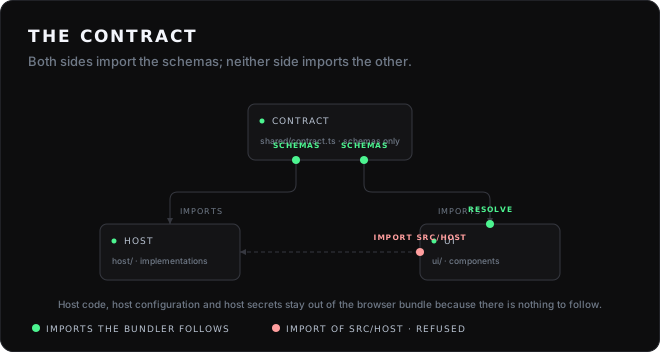
A contract is data: a table of operations and streams, each with schemas for its input and output. Both sides import it; neither imports the other. Because it holds no implementation, a bundler following the browser's import of the contract does not pull the host in with it — which is what keeps host code, host configuration and host secrets out of the browser bundle. There is a test that asserts a browser bundle importing broapp/host fails the build.
Underneath, a contract maps onto Brobridge's existing surface and nothing more. An operation "notes.list" is exactly bridge.expose("notes", { list }) on the host and bridge.call("notes.list", input) in the browser. There is no second dispatch path, no parallel protocol, and nothing to keep in step.
Validation and the error boundary
Input is validated on the host, always, before a handler sees it. The browser also validates before sending — but only as a convenience: the host's check is the boundary, and a test bypasses the client to prove it.
Errors cross the boundary in exactly two ways. An error a handler raises deliberately with PublicError keeps its message. Everything else is logged on the host, with its stack, and reaches the browser as a fixed sentence. Broapp does not have to redact anything for the second case — Brobridge already reduces a non-BridgeError throw to "internal error" — so Broapp gets out of the way and lets it happen.
Streams
Brobridge streams carry bytes, not messages. A chunk delivered to a consumer may hold two events, half an event, or the tail of one and the head of the next. Broapp frames events as newline-delimited JSON rather than assuming one chunk is one event, because the assumption holds in testing and fails in production.
Cancellation is the part worth reading carefully. It is covered in streaming.md; the short version is that abandoning an async iterator does not cancel the stream underneath it, so the browser must call cancel() explicitly, and the host learns about it through stream.closed rejecting.
Lifecycle
Two modes, both explicit. interactive (the default) exits shortly after the last browser tab detaches, unless work is running. background keeps going until it is stopped.
"Attached" is not "a session exists": Brobridge retains a session after its socket drops so a reconnecting tab can resume, so counting sessions would keep an interactive host alive for a minute after the last tab closed. Attachment is endpoint.state === "open". Attachment is also recorded from Brobridge's session hook rather than by polling, so a tab that connects and closes between two polls is not mistaken for a browser that never arrived.
See lifecycle.md.
What Broapp adds, in one list
- A generator that refuses unsafe destinations and never overwrites your files.
- A typed contract, with runtime validation on the host.
- NDJSON framing over Brobridge's byte streams.
- Cancellation surfaced as an
AbortSignal. - A single-document build with a hash-pinned CSP and an off-origin check.
- Single-file compilation with the UI embedded, for six targets.
- Two documented lifecycle modes with real shutdown.
- A per-user data directory, resolved once, overridable.
- One development command that does not spawn a tab per save.
- An optional, host-only AI layer: settings, key storage, context, tools derived from the contract, and confirmation before anything changes.